Skip to content

Cart

Your cart is empty

The Icelandic Store

Knitting Patterns by Istex

Authentic Icelandic goods
Direct from Iceland, worldwide
2,130 verified customer reviews
Family-run since 2013

Sort by

402 products

Boy by a dark lava rock in the Lopi 18 no. 30 sweater, in the pattern’s original colours — monet, a mid-blue tweed with small coloured flecks (no longer made), with a yoke of light denim diamonds with copper-orange centres (copper is no longer made) outlined in navy, small orange crosses and pale spikes up to the folded neckband, and a matching border above the hem and cuffs. The orange collar of the top under it and the jeans are not part of the pattern
Boy in tall dry grass in the Lopi 18 no. 29 sweater, shown in the pattern’s original colours — green heather (9737, no longer made) with a round yoke of black and white zigzag bands and a row of small white diamonds, a black and white zigzag border above the ribbed hem, and a ribbed neckband. His arms are behind his back, so the cuffs do not show. The dark trousers are not part of the pattern
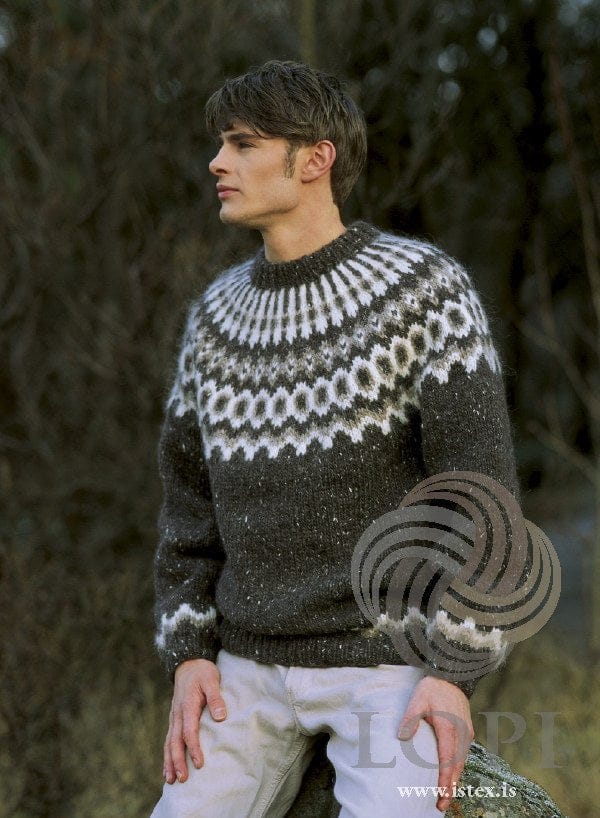
Man seated on a mossy rock in the Lopi 18 no. 28 sweater, shown in the pattern’s original colours — black sheep tweed, a very dark brown-black with small white flecks (9452, no longer made), with a white and oatmeal yoke of a zigzag band, a row of rings, small motifs and white stripes rising to the neck, and a zigzag border above the cuffs. His pale trousers are not part of the pattern
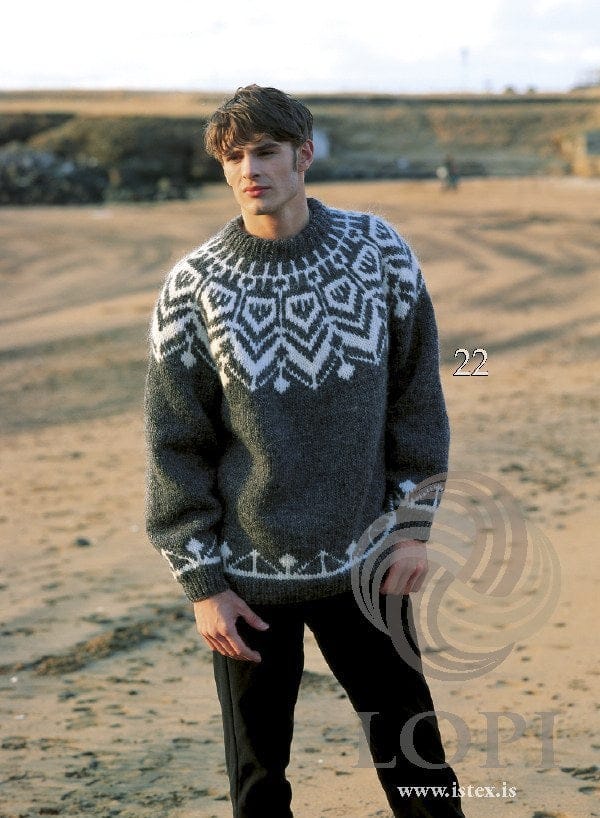
Man on a beach in Design 22 of this pattern, in its own colours — dark gray with a white yoke of large pointed shapes, zigzags and small diamonds, a white border of diagonal lines and small trees above the hem and cuffs, and a folded rib neckband. His black trousers are not part of the pattern
A young man and a boy on a sandy beach, both in the pattern’s original colours. On the left, marked 20, Design 20 — brown tweed with small white flecks (9453, no longer made), with a yoke of raised brown-and-white marled cells and a marled collar. On the right, marked 21 and pointing, Design 21 — light grey tweed with dark flecks (9451, no longer made) and dark marled cells. The black trousers are not part of the pattern
Woman by a dark stone wall in Design 18, in the pattern’s own colours — light denim heather with a yoke of a white zigzag, white slanting leaves on dark denim, a navy band and white spikes up to a folded navy neckband, and a white zigzag above the navy hem and cuff rib, which starts with a white edge. The white polo neck under the sweater and the jeans are not part of the pattern
Woman in front of dark trees in the Lopi 18 no. 17 sweater, shown in the pattern’s original colours — medium brown tweed with small white and black flecks (9453, no longer made), a yoke of black heather diamonds framed in white with smaller motifs and white tulip-like shapes above, a short opening with three dark buttons, a folded-over rib collar, and a white and black heather border above the hem and cuffs. Her cream polo neck and dark trousers are not part of the pattern
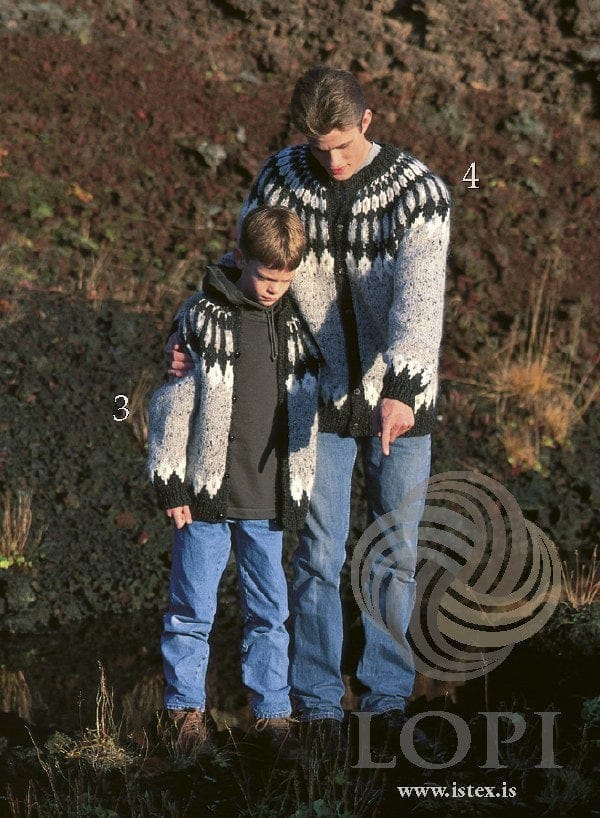
A boy (marked 3) and a young man (marked 4) outdoors, each in one of this pattern’s cardigans, in the original colours — light gray tweed (9451, no longer made) with black heather rib and front bands, small dark buttons, a white and black heather border above the rib, and a yoke of white motifs, a black heather band and long grey and black pillars rising to the neck. The boy’s is open, the man’s buttoned. The boy’s dark hoodie, the man’s grey T-shirt, their jeans and shoes are not part of the pattern
By the sea: the older boy, marked 12-32, in No. 32 — oatmeal heather with a yoke of a white zigzag, black heather diamonds and white spikes with an acorn-brown stripe across them, the same border above the hem and cuffs — and the long stocking hat, tied near the top with a dark cord, in the pattern’s own colours. Not part of this pattern: his green neck-warmer and dark trousers, and the sweater, hat, red neckerchief, fishing rod and jeans of the girl, marked 12-34, who wears a different pattern
Boy with a black-and-white dog in No. 28, the blue version of this pattern — a blue body with navy rib at the hem and cuffs and a navy neckband, small white motifs above the rib, and a yoke with a white band of navy star motifs, a white zigzag edge and white rays up to the neck, shown in the original colours (the blue, 0098, is no longer made); the photo has a blue cast. His jeans and the dog are not part of the pattern
Laughing boy on a red see-saw beside Icelandic horses in the Lopi 12 no. 25 sweater and hat, shown in the pattern’s original colours — bright blue with small white flowers ringed in darker blue on the yoke, a dark border with white dots above the rib at the hem and cuffs, and a plain dark blue hat with a rolled edge (both blues are no longer made). His white trousers and shoe are not part of the pattern
Smiling man on a ship’s deck in the Lopi 12 no. 9 sweater, hat and a fingerless glove, in the pattern’s original colours — dark olive green with a deep yoke of pale grey scallops and honeycomb shapes filled with khaki and dark green, a matching border above the hem rib, and a plain rolled-edge hat (both greens are no longer made). His jeans, the top at his neck and the rope-wrapped pole are not part of the pattern; the woman in front, in a scarf, wears another pattern, Lopi 12 no. 7 (she is on its cover)
Woman sitting against a weathered wooden ladder on grey rocks in the Lopi 12 no. 1 sweater and beret, shown in the pattern’s original colours — a brick red body, a yoke of black fir trees, two bands of blue and black checks and black lines up to a ribbed stand-up collar, deep ribbed hem and cuffs, and black and blue blanket stitch along the edges (9392 and 9300 are no longer made). Her jeans, black gloves, earrings and laced boot are not part of the pattern
Smiling woman in the Hún cardigan, worn open, shown in the pattern’s original colours — short sleeves, bands of stars, diamonds and small crosses in camel and ash on black, hazel brown stripes with rows of rust eyelets, black moss-stitch edges, and small buttons and loops down the front (hazel and camel are no longer made). The pale satin top under it is not part of the pattern
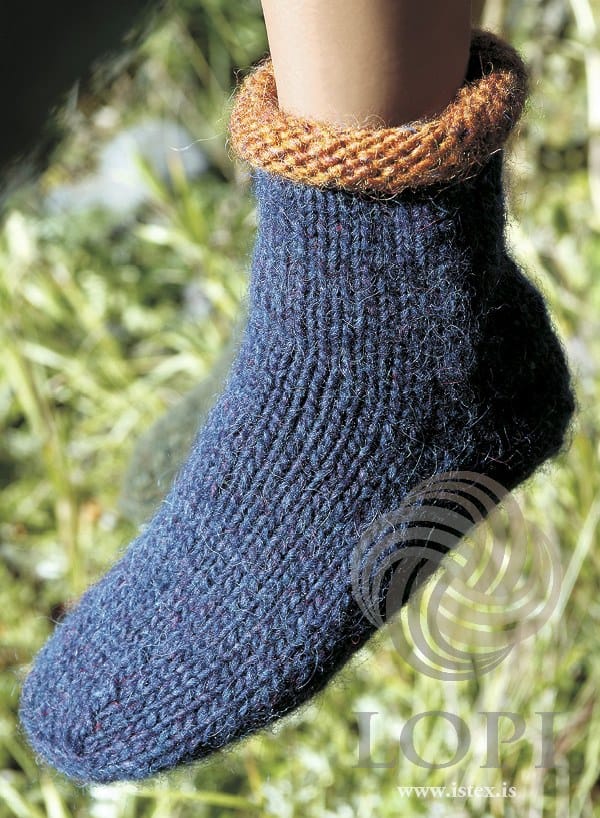
One Uni ankle sock on a foot against sunlit grass — plain stocking stitch in a deep blue heather with a rolled amber top edge, a plain foot and a blunt toe, shown in the pattern’s original colours: sapphire blue heather (9968, no longer made) and amber heather (9971)
Young woman by a stone wall in U — a long sleeveless tunic with one braided cable up the centre front and a deep K2, P2 rib collar falling into a cowl, shown in the pattern’s original colour, pond heather (9736, no longer made), a dark petrol-blue heather. The black long-sleeved top, the pink plaid skirt, the dark tights, the bracelet, the hairband and the pink cabled bag are not part of the pattern
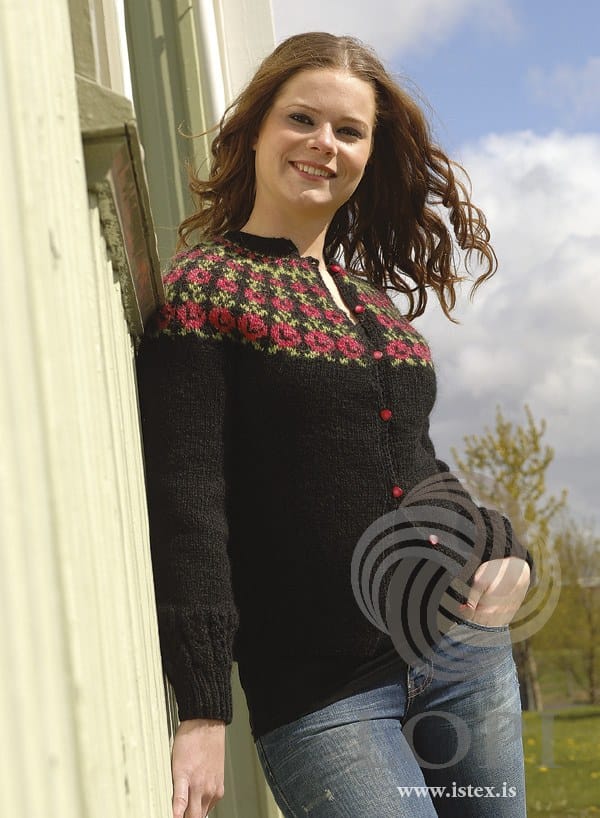
Woman leaning on a pale green wooden wall in Þyrnirós — a fitted black cardigan with a round yoke of red roses and green leaves, eyelet bands above the ribbed cuffs and small red buttons up the front, shown in the pattern’s original colours (the light red of the roses is no longer made). Her jeans are not part of the pattern
Smiling boy by a rusty corrugated-iron wall in Tat — a brown marl crew-neck sweater flecked with grey-teal, a dark brown rib neckband and a dark amber zigzag band on each upper sleeve, shown in the pattern’s original colours (the sea green in the marl is no longer made). His jeans are not part of the pattern
Young woman in Stafir, the grey version — a long-sleeved sweater dress in dark grey with a yoke of white stars, one small black motif at the front of the yoke, deep rib at the hem and cuffs and a white turtleneck collar, shown in the pattern’s own colours (all still made). The hairband and the black tights are not part of the pattern
Three pairs of Sokkar children’s socks laid on grass with yellow buttercups — the pattern’s three versions in their original colours: sun yellow at the top (no longer made), glacier blue turquoise in the middle and spring green at the bottom right. Plain stocking stitch with K1, P1 rib cuffs
Man in a street of old houses wearing Rökkur from Lopi 24, shown in the pattern’s original jungle green (9980, no longer made), which knits up in uneven olive and near-black bands — moss stitch all over, no rib at the hem or cuffs, a high stand-up collar and a front zip, here open to mid-chest. The black T-shirt and the jeans are not part of the pattern
Ravenna hung over an old wooden frame outdoors, with the sea and sky behind and plants at the side, in the pattern’s original colours (sapphire blue heather is no longer made) — bands of golden, amber, ruby red, fuchsia, deep blue, teal, chartreuse, cypress green and black tweed crossing over and under each other, each outlined in ecru, inside a wide ecru moss-stitch border. The wooden frame is not part of the pattern
Manhattan Hat laid flat, the version with ears, in the pattern’s own colours — a galaxy seed-stitch brim and dark buildings with apricot and mimosa windows, an air blue sky with a few air blue windows in the tallest buildings, and fjord blue above, rising to two little ears at the top
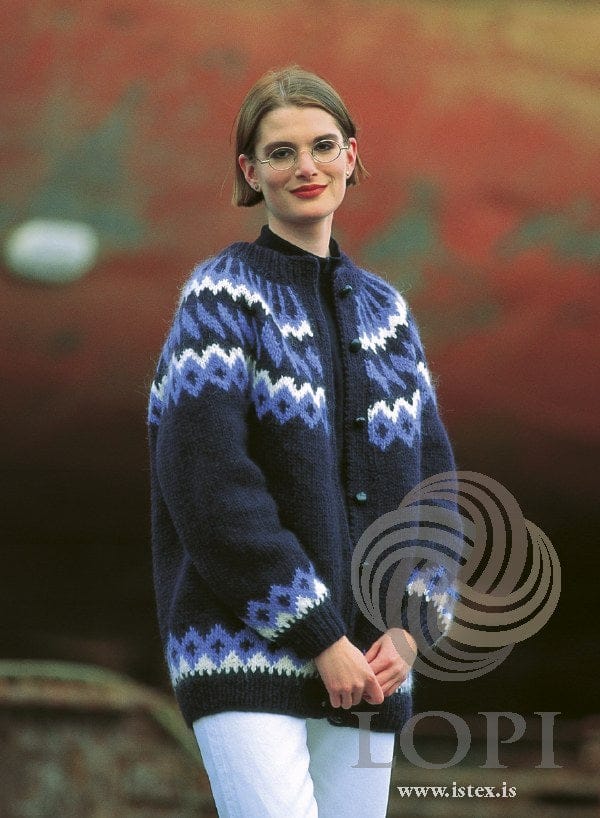
Woman in the Lopi 12 no. 15 cardigan, buttoned, shown in the pattern’s original colours — navy with a yoke of white zigzags, periwinkle blue diamonds and long blue shapes rising to the neck, matching blue and white borders above the ribbed hem and cuffs, and dark buttons up the front. The blue (9390) is no longer made. Her black polo neck, white trousers, glasses and earrings are not part of the pattern
Man in a sunlit wood in the Lopi 12 no. 10 cardigan and hat, shown in the pattern’s original colours. The cardigan, worn open, is chocolate brown with a deep white yoke of brown and black heather motifs ending in points, the same border on the cuffs and above the hem, and buttons on ribbed front bands; the hat is a dark tweed with a rolled edge (9239, no longer made). The red plaid shirt, the white T-shirt, the belt and the dark jeans are not part of the pattern
Leggur leg warmers in the Roses version, worn while lacing a hiking boot on a rock — hazel brown with a twisted-rib top and a band of stone blue roses and celery green leaves on black just below it, shown in the pattern’s original colours (hazel is no longer made). The brown sweater, the dark trousers and the hiking boots are not part of the pattern
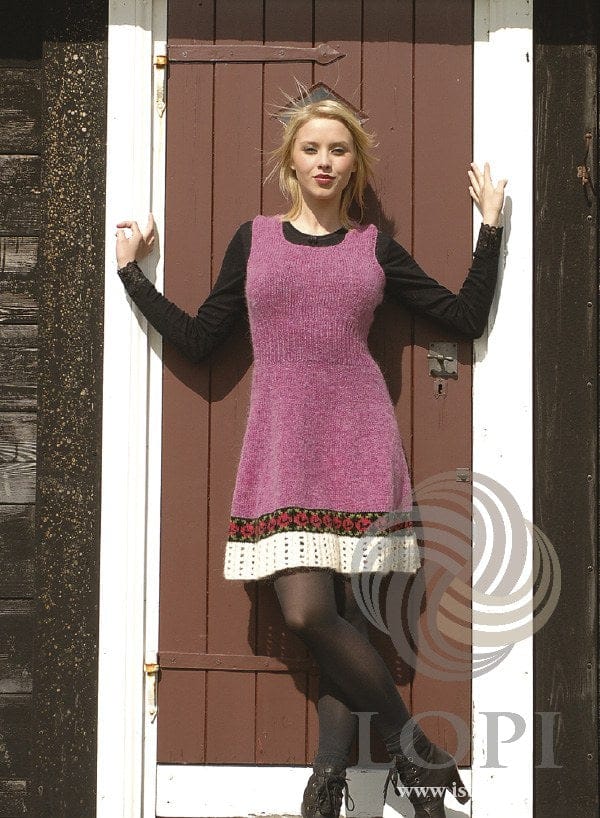
Woman in a doorway in Klukka, the pink version — a pink sleeveless dress with a scoop neck, a ribbed waist, a black band of red roses and green leaves and a white eyelet-rib hem, shown in the pattern’s original colours (the light red of the roses is no longer made). Her black long-sleeved top, black tights and ankle boots are not part of the pattern
Woman in front of a green goal net wearing Hálka — a white Jöklalopi hat with the deep rib brim turned up and a band of white motifs on mountain blue above it, shown in the pattern’s original colours (mountain blue, 1415, is no longer made). Her blue V-neck sweater, the white T-shirt under it and the dark grey knitted sleeve at the right edge are not part of the pattern
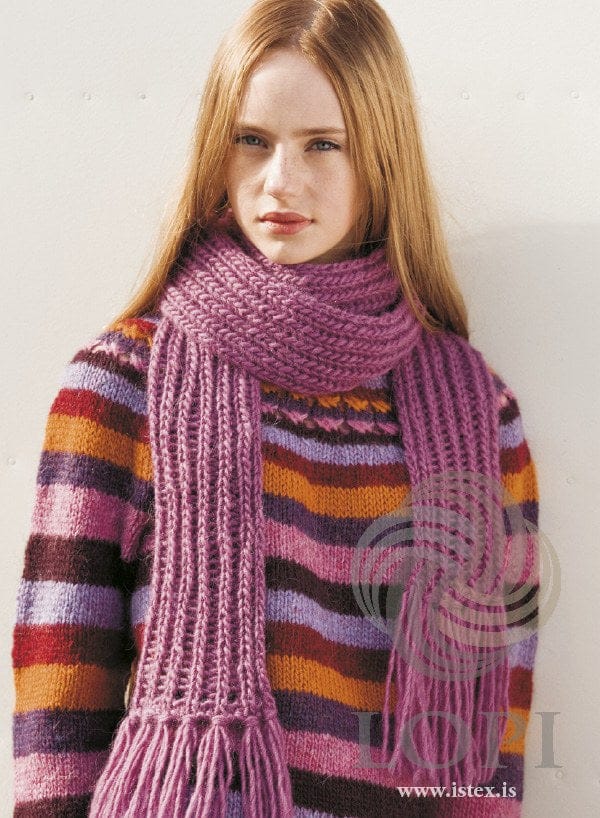
Young woman wearing Glypja, shown in the pattern’s original orchid (0159, no longer made) — a dusty pink-purple Álafosslopi scarf wrapped once round her neck, with open ladders between the ribs and a tassel fringe at both ends hanging down the front. Her striped sweater is a different pattern (Kross, Lopi 28) and is not part of this pattern
Smiling boy against a red wall in Fés, the grey version, in the pattern’s own colours — a grey Léttlopi sweater with three rows of black faces with crimson eyes and white mouths on ash in the yoke, and a matching dotted border above the rib at the hem and cuffs. His jeans are not part of the pattern
Two children at a white wooden railing in Él sweaters, both in the pattern’s original colours. On the left, the purple version — hyacinth (no longer made) with the yoke patterned in midnight blue and a dark line at the base of the neckband; on the right, the blue version — winter blue with a white yoke of small blue diamonds and flowers and a white line at the base of the neckband. Their jeans are not part of the pattern
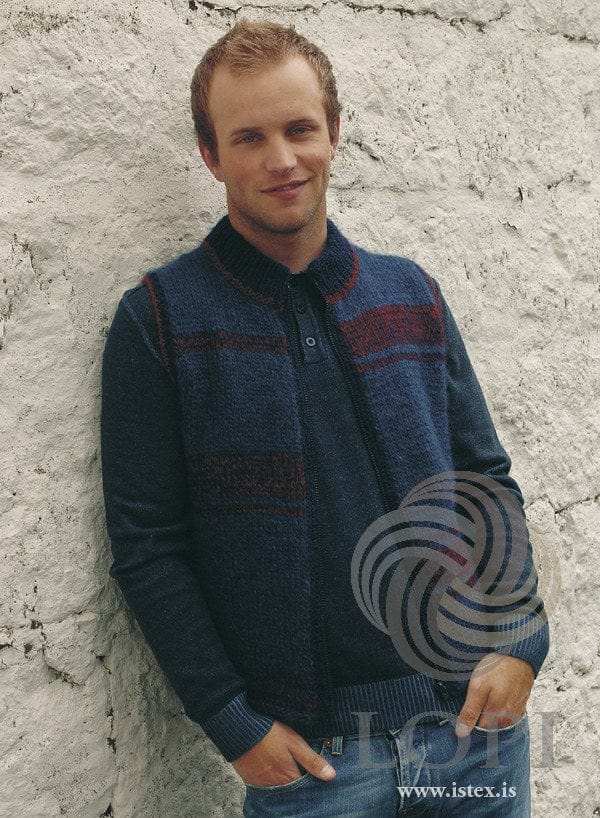
Man leaning on a whitewashed wall in the Boði zip vest, worn open — blue Álafosslopi with speckled navy-and-red stripe blocks at different heights on the two fronts, narrow navy front bands, a high navy collar with a red line at its base and red-tipped armhole edges, shown in the pattern’s original sapphire blue (no longer made). The dark polo-collar sweater under it and the jeans are not part of the pattern
A pair of Bjalla children’s mittens on water-lily leaves, with a white water-lily flower above them — long flared brioche cuffs with a garnet red top edge, a ribbed wrist and a plain hand, shown in the pattern’s original lilac (no longer made) and garnet red
Woman among Icelandic sheep, holding a horned sheep by its horns, in the Icelandic Zip Cardigan zipped up — the pattern’s black version, a short black heather cardigan with a folded rib collar and a round yoke patterned in oatmeal and white; the warm light makes it look browner than it is. Her mittens, dark trousers and the dark top showing at her neck are not part of the pattern, nor are the clothes of the people behind her
Woman in front of a grey wooden house in Þel, the dark brown version, shown in the pattern’s original hazel (no longer made) — K2, P2 rib, a high ribbed collar held closed at her chest, and the two fronts crossing and hanging in long points below the hip. Her necklace and the white skirt are not part of the pattern
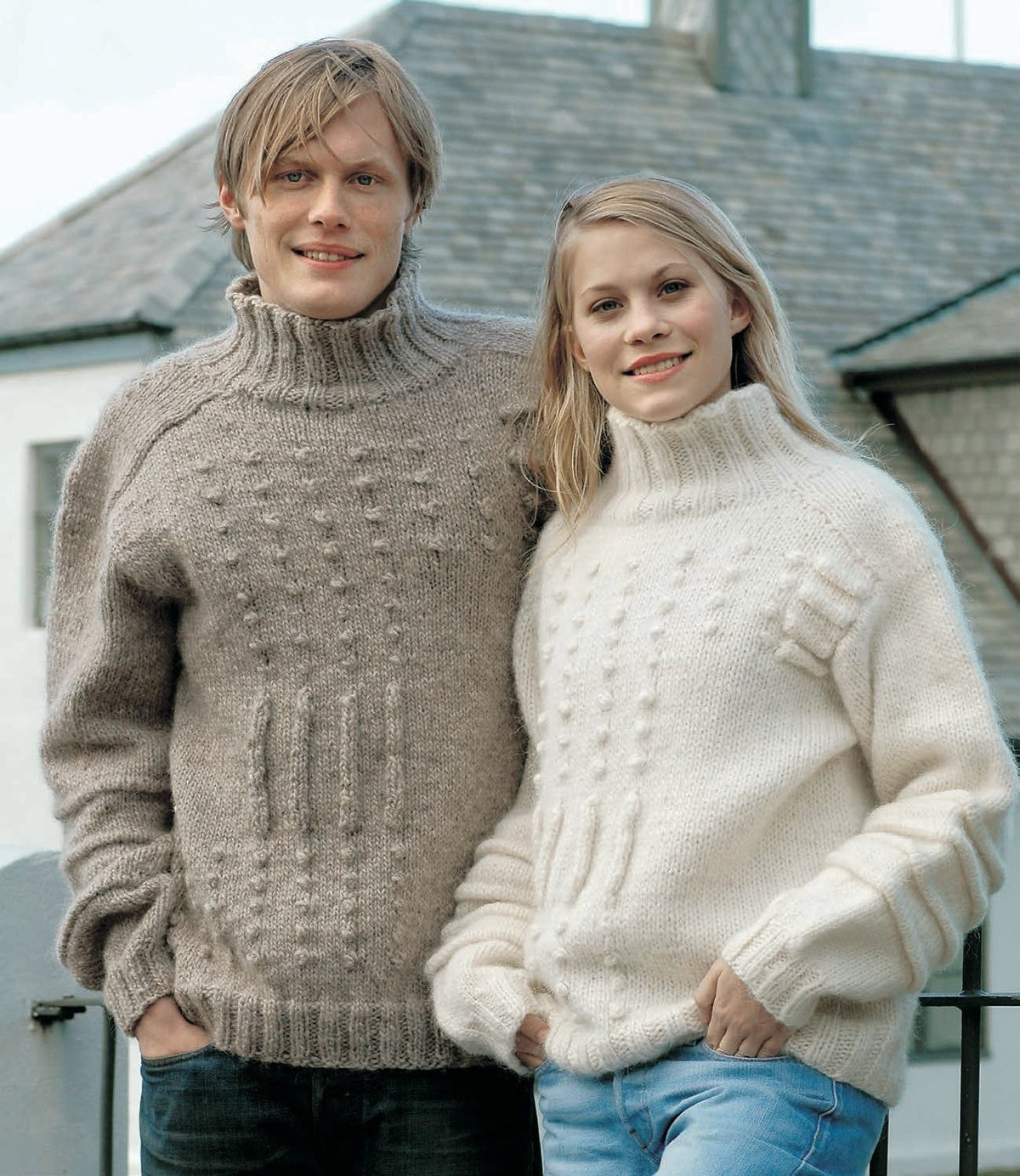
A man and a woman in Tattó in front of a white house with a slate roof, in the pattern’s two colours: he wears light beige heather, she wears white. Columns of small bobbles and four raised vertical strips on the front and a tall K2, P2 rib collar; on her sweater a block of horizontal tucks by her left armhole and tucks round her left sleeve. Their jeans are not part of the pattern
Smiling woman in Snjór, shown in the pattern’s white Jöklalopi — a chunky brioche-stitch hat with deep ribs, a turned-up brim and a large crocheted flower with chain loops at its centre, near the top at one side. Her black fur jacket is not part of the pattern
Young woman seen from the back and side in Skjól, in the pattern’s bottle green Léttlopi — a ribbed back panel across her lower back, the scarf rising from its side towards the front, and a high ribbed collar round the back of her neck, with her upper back left open. Her light blue top, earring, studded belt and jeans and the orange chair behind her are not part of the pattern
Smiling woman wearing Rjúpa in the pattern’s colours — a white eyelet-lace turtleneck standing up round her neck and, over the shoulders, zigzag bands of light beige and acorn and white crosses on a black band. A narrow black ribbon is threaded through the eyelets at the base of the white collar and tied in a bow at the front. The denim jacket is not part of the pattern
Smiling woman by a white wooden gate in Pífa, shown in the pattern’s own colours — a black flared skirt ending just above the knee, with a border of light beige and acorn zigzags around a black band of small white crosses, and a white eyelet-lace frill at the hem. Her white hat with a crocheted flower is Snjór, a different pattern from the same book; the black fur vest, black top, long black gloves and dark tights are not part of the pattern
Boy wearing Nei in the pattern’s black heather Jöklalopi — a deep ribbed band, turned up in the photo, and a plain stocking-stitch crown. The sweater is Haus, a separate pattern from the same book; the necklace is not part of the pattern
Two women in Miðja, the sand and black version with long sleeves, in the pattern’s own colours — sand lace shading through dark brown waves to a black twisted-rib waist, a scalloped hem at the knee and scalloped sleeve ends. The black boots, the seated woman’s black gloves and the stool she sits on are not part of the pattern
Two children in front of Icelandic horses. The boy on the right wears the Lopi 12 no. 27 sweater — light grey ash heather with a white and black heather yoke: a scalloped white band, small dark diamonds and white stems at the neck, with a matching border above the hem and cuffs — and the plain grey rolled-brim hat from the same leaflet, in the pattern’s own colours. His dark trousers are not part of the pattern; the child on the left wears Lopi 12 no. 29, a different pattern, with jeans and a neck scarf
Man in the white Lopi 12 no. 22 sweater among trees — black heather points topped with ash grey and a band of white ovals framed in acorn on the yoke, with a matching band above the rib at the hem and cuffs, shown in the pattern’s own colours. His black polo-neck top and dark jeans are not part of the pattern. The woman wears Lopi 12 no. 2, a different pattern — a long black cardigan and beret — with grey tights
Man in the Lopi 12 no. 18 sweater in front of fir trees — a light grey ash heather body, black heather motifs on the yoke rising into a white band near the neck, and a black border above the hem and cuffs, shown in the pattern’s own colours. His lilac neckerchief and black trousers are not part of the pattern. The woman wears Lopi 12 no. 14, a different pattern; her black hat, red scarf and light trousers are not part of this one either
Girl at the top of a playground slide in Lappi, the red version, in the pattern’s own colours — a crimson red zip cardigan with a black zip, and a round yoke of spring green, a row of small black four-legged animals on white, blue bands with white dots and a turquoise band with white blocks, with a narrow green band and black dots on the neckband. The white top under it and the light jeans are not part of the pattern
Woman by a wooden railing in the Lopi 12 no. 8 cardigan, shown in the pattern’s own colours — white and hip length, with a round yoke of white ovals with light beige centres set in light ash, light ash stripes at the neck, patterned light ash borders at the hem and cuffs, narrow light ash front bands and silver-tone clasps. Her white polo-neck top, headband and gloves, her cream trousers and the man’s dark yoke sweater (Lopi 12 no. 20, a different pattern) are not part of this pattern
Woman among trees in the Lopi 12 no. 2 cardigan and beret, shown in the pattern’s own colours — a long black cardigan to mid-thigh with a round yoke of white tree motifs and grey heather and white bands above them, six pale buttons down the front, and a black beret. The tall black polo collar at her neck, her grey tights and the man’s white yoke sweater (Lopi 12 no. 22, a different pattern) are not part of this pattern
Boy by the sea in Haus, from the front, in the pattern’s colours — a black heather Álafosslopi sweater with one white stripe across the upper chest and a ribbed crew neck. The ribbed hat is Nei, a separate pattern from the same book; the jeans and the necklace are not part of the pattern
Smiling woman with a bicycle wearing both pieces of Fjúk in the pattern’s black tweed Álafosslopi — the felted hat with its turned-down brim and a band above it, and the long, narrow garter-stitch scarf round her neck with a big white pompom at each end. The denim jacket, the black polo neck, the black skirt with grey bands at the hem and the bicycle are not part of the pattern

Knitting patterns by Istex, the spinner of Iceland's classic Lopi yarns, covering authentic lopapeysa sweaters, cardigans and accessories. Each pattern is written for genuine Icelandic wool so your finished piece looks and wears as intended.

Instant inspiration, shipped worldwide from Iceland.