
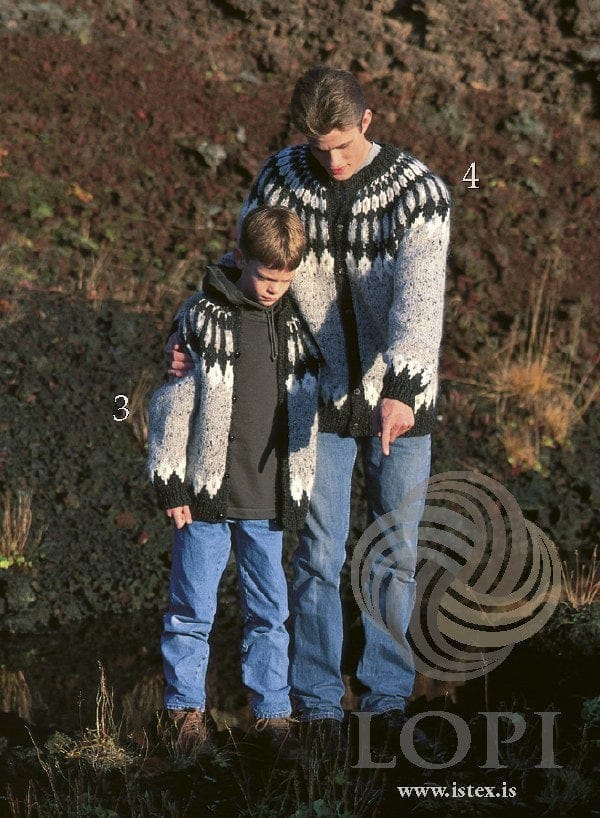
Lopi 18 No. 3 & 4 — Yoke Cardigan for Children and Adults Knitting Pattern
Matching buttoned yoke cardigans — No. 3 for children, No. 4 for women and men · Álafosslopi in three colours · one version · 110–152 cm tall and XS–XL
Pattern only: the English PDF, emailed to you right after purchase. Yarn is not included.

- Free shipping over $149 — US, Canada & Europe
- Digital download — nothing is posted, so no shipping cost or duties
- Emailed right after purchase
- English PDF, 6 pages, emailed right away
- Lopi 18, nos. 3 and 4 — Astrid Ellingsen
- 110–152 cm tall · XS–XL · chest 80–121 cm
Lopi 18 nos. 3 and 4 are one leaflet: Astrid Ellingsen’s matching round-yoke cardigans from Ístex’s Lopi 18 — No. 3 for children, to fit 110 to 152 cm tall, and No. 4 for adults, XS to XL, with sleeve lengths for women and for men. Each has its own instructions and charts. Both are Álafosslopi in light gray tweed with black heather rib and front bands, a yoke of white motifs, a black heather band and long grey and black pillars rising to the neck, and a matching border above the hem and cuffs; both are knitted in the round, cut open at the front and buttoned. The main colour, light gray tweed (9451), is no longer made; the white and the black heather still are.
What you get
- The knitting pattern in English (PDF), emailed right after purchase — nothing is posted
- Both numbers: No. 3, the children’s cardigan, and No. 4, the adults’ — each with its own instructions and charts
- No. 3 in five sizes, to fit 110–152 cm tall; No. 4 in five sizes, XS to XL
- Sleeve lengths and button sides for women and for men, and button sides for girls and boys
- Yarn and needles are not included. The kits have this pattern and all the yarn: the children’s No. 3 kit or the adults’ No. 4 kit
Yarn used in the pattern (not included)
No. 3, children’s cardigan: Álafosslopi — 100 g balls · to fit 110 (122 134 140 152) cm tall — No. 3’s list prints 9451 as “light gray”; its chart key, like No. 4’s, says light gray tweed
M 9451 light gray tweed — 3 (3 3 4 4) · no longer made — the children’s No. 3 kit uses 9974 light grey tweed, the same kind of yarn, a little lighter
A 0051 white — 1 (1 1 1 2)
B 0005 black heather — 2 (2 3 3 3)
No. 4, adults’ cardigan: Álafosslopi — 100 g balls · sizes XS (S M L XL) — one set of amounts for both sleeve lengths
M 9451 light gray tweed — 5 (5 6 6 7) · no longer made — the adults’ No. 4 kit uses 9974 light grey tweed, the same kind of yarn, a little lighter
A 0051 white — 2 (2 2 2 2)
B 0005 black heather — 3 (3 3 4 4)
No. 3, children’s cardigan — five sizes by height
| 110 | 122 | 134 | 140 | 152 | |
|---|---|---|---|---|---|
| To fit height | 110 cm 43¼″ |
122 cm 48″ |
134 cm 52¾″ |
140 cm 55″ |
152 cm 59¾″ |
| Chest | 80 cm 31½″ |
85 cm 33½″ |
90 cm 35½″ |
94 cm 37″ |
99 cm 39″ |
| Length to centre front neck | 42 cm 16½″ |
46 cm 18″ |
50 cm 19¾″ |
54 cm 21¼″ |
58 cm 22¾″ |
| Sleeve length to underarm | 25 cm 9¾″ |
29 cm 11½″ |
33 cm 13″ |
35 cm 13¾″ |
38 cm 15″ |
No. 4, adults’ cardigan — five sizes, with sleeve lengths for women and for men
| XS | S | M | L | XL | |
|---|---|---|---|---|---|
| Chest | 103 cm 40½″ |
108 cm 42½″ |
112 cm 44″ |
117 cm 46″ |
121 cm 47¾″ |
| Length to centre front neck | 62 cm 24½″ |
65 cm 25½″ |
68 cm 26¾″ |
70 cm 27½″ |
72 cm 28¼″ |
| Sleeve to underarm, women | 41 cm 16¼″ |
43 cm 17″ |
43 cm 17″ |
45 cm 17¾″ |
45 cm 17¾″ |
| Sleeve to underarm, men | 46 cm 18″ |
48 cm 19″ |
48 cm 19″ |
50 cm 19¾″ |
50 cm 19¾″ |
Gauge
13 sts × 18 rows = 10 cm (4″) in stocking stitch on 6 mm needles.
Needles
No. 3: 4.5 mm (US 7) and 6 mm (US 10) circular needles, 60 cm, and 4.5 mm and 6 mm double-pointed needles
No. 4: 4.5 mm (US 7) circular needle, 80 cm, 6 mm (US 10) circular needles, 40 and 80 cm, and 4.5 mm double-pointed needles
By our reading No. 4 also needs 6 mm (US 10) double-pointed needles for the sleeves: they change to 6 mm with only 42 to 48 stitches, too few for a 40 cm circular. No. 4’s list leaves them out; No. 3’s list has them
The pattern calls a circular needle a “twin pin”
You will also need
Buttons — 5 (6, 6, 6, 6) for No. 3 and 6 (6, 7, 7, 7) for No. 4; the pattern gives no size — and stitch holders, both in the pattern’s lists; a sewing machine and thread for the stitching before the front is cut; and a tapestry needle for sewing on the bands, slip-stitching the facings and the neckband and grafting the underarms.
How it is knitted
Both cardigans are made the same way. The welt is K1, P1 rib in black heather, knitted back and forth on the 4.5 mm circular with the first and last stitch knitted on every row and a buttonhole at 2 cm — 5 (5, 5, 5, 6) cm deep for No. 3 and 6 (6, 6, 7, 7) cm for No. 4. The stitches for the front bands — 6 at each edge for No. 3, 8 for No. 4 — go onto holders, and the rest are increased to 101 (107, 113, 119, 125) stitches for No. 3 or 131 (137, 143, 149, 155) for No. 4. On 6 mm, 2 stitches are cast on at the centre front and purled all the way up, and the body is knitted in the round: a 12-round border of white and black heather from chart 1 (10 rounds in sizes 110 and 122), then light gray tweed to 25 (28, 30, 33, 36) cm for No. 3 or 38 (40, 42, 43, 44) cm for No. 4. The sleeves are knitted in the round from a black heather cuff of K1, P1 rib on 4.5 mm double-pointed needles, get the same border on 6 mm and are increased — every 6th round in No. 3; every 8th round for women or every 9th for men in No. 4. Body and sleeves are joined for the round yoke: a 35-round chart for No. 3 and a 43-round chart for No. 4, each with four decrease rounds; the smaller sizes leave out marked rounds. Two rows of machine stitching go up the centre of each purl column at the front; the pattern says to cut between them only once the button band is knitted. Each band is knitted from its held stitches in black heather rib, with 3 stitches cast on for a stocking-stitch facing, until it reaches the neckline when slightly stretched; it is sewn on in line with the welt, and the facing is folded over the cut edge on the wrong side and slip-stitched. The buttonhole band matches it. The neckband is knitted back and forth in black heather rib across the bands and the yoke, with one more buttonhole, folded in half to the inside and slip-stitched, and the underarm stitches are grafted.
Design: Astrid Ellingsen — pattern from Lopi No. 18 (nos. 3 and 4), Ístex.
More info — download, yarn & help
How you get it — the pattern is a PDF in English. It is emailed to you right after purchase; nothing is posted.
Yarn — not included. We sell Ístex lopi by the ball in our yarn shop, or choose the kit, which has this pattern and all the yarn in one parcel.
No email? Check your spam folder, then write to support@icelandicstore.is with your order number. A person answers, Monday to Friday.
Choose options
Why you'll love it
- Pillar yokeWhite motifs, a black heather band and long black heather and grey pillars rising to the neck.
- Child and adultThe children’s No. 3 and the adults’ No. 4 are the same design in the same colours — the pair in the photo.
- Girl or boy, woman or manThe buttonholes go on the right front for girls and women and on the left front for boys and men; No. 4 also has two sleeve lengths.
- Neat insideBlack heather front bands with a knitted facing that folds over the cut edge and is sewn down, and a neckband folded in half to the inside.
- Cut or knit flatKnit it in the round and cut the front open, or knit the body, sleeves and yoke back and forth — the pattern explains both.
Good to know