
Lopi 12 No. 3 & 4 — Zigzag Yoke Sweater Knitting Pattern
Round-yoke sweater for women and men with a zigzag yoke · Álafosslopi · two versions, No. 3 black and No. 4 grey · sizes XS–XL
Pattern only: the English PDF, emailed to you right after purchase. Yarn is not included.

- Free shipping over $149 — US, Canada & Europe
- Digital download — nothing is posted, so no shipping cost or duties
- Emailed right after purchase
- English PDF, 4 pages, emailed right away
- Lopi 12, nos. 3 and 4 — Astrid Ellingsen
- Sizes XS–XL · chest 98–123 cm
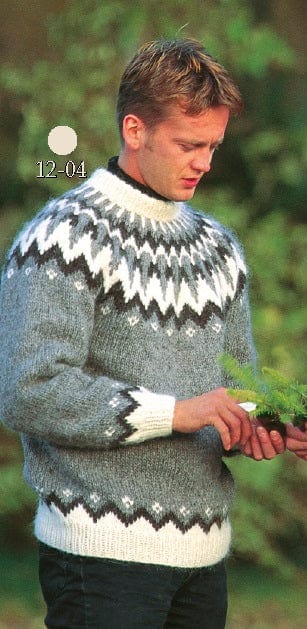
Lopi 12 nos. 3 and 4 are one pattern: Astrid Ellingsen’s round-yoke pullover from Ístex’s Lopi 12, knitted in Álafosslopi in the round from the bottom up, for women and men, with a sleeve length for each. The leaflet gives two colour versions side by side, with the same amounts. No. 3 is black, with copper rib at the hem and cuffs, a yoke of white and copper zigzags with black pointed shapes, and a high black neck; No. 4 is grey, with white rib, a yoke of white zigzags edged in black sheep, and a folded white neckband. Both have a matching border above the rib and come in five sizes, XS to XL. The leaflet prints only the colour numbers; No. 3’s copper (9384) is no longer made, and every other colour is.
What you get
- The knitting pattern in English (PDF), emailed right after purchase — nothing is posted
- Both numbers in one pattern: No. 3, the black version, and No. 4, the grey version — one set of instructions
- Five sizes, XS to XL
- Sleeve lengths for women and for men
- Two charts — the border above the hem and cuffs, and the yoke — with a key for both versions
- Yarn and needles are not included. For No. 4, our grey kit has this pattern and all the yarn; we have no kit for No. 3
Yarn used in the pattern (not included)
No. 3, black: Álafosslopi — 100 g balls · sizes XS (S M L XL) — the leaflet prints only the colour numbers; black, copper and white are the names Ístex prints for them in its Lopi 18 leaflets
M 0059 black — 5 (6 6 7 7)
A 9384 copper — 3 (3 3 3 3) · no longer made by Ístex — we have no kit for No. 3
B 0051 white — 2 (2 2 2 2)
No. 4, grey: Álafosslopi — 100 g balls · sizes XS (S M L XL) — the leaflet prints only the colour numbers; the names are the ones Ístex prints for them in its other leaflets (grey in Lopi 28 no. 7, white and black sheep in Lopi 18)
M 0057 grey — 5 (6 6 7 7)
A 0051 white — 3 (3 3 3 3)
B 0052 black sheep — 2 (2 2 2 2)
Sizes
| XS | S | M | L | XL | |
|---|---|---|---|---|---|
| Chest | 98 cm 38½″ |
105 cm 41¼″ |
111 cm 43¾″ |
117 cm 46″ |
123 cm 48½″ |
| Length to centre front neck | 62 cm 24½″ |
65 cm 25½″ |
68 cm 26¾″ |
70 cm 27½″ |
72 cm 28¼″ |
| Sleeve length, women’s | 41 cm 16¼″ |
43 cm 17″ |
43 cm 17″ |
45 cm 17¾″ |
45 cm 17¾″ |
| Sleeve length, men’s | 46 cm 18″ |
48 cm 19″ |
48 cm 19″ |
50 cm 19¾″ |
50 cm 19¾″ |
| Body, cast-on edge to underarm | 38 cm 15″ |
40 cm 15¾″ |
42 cm 16½″ |
43 cm 17″ |
44 cm 17¼″ |
Gauge
13 sts × 18 rows = 10 cm (4″) in stocking stitch on 6 mm needles.
Needles
4.5 mm (US 7) circular needle, 80 cm, for the hem rib
6 mm (US 10) circular needles, 40 and 80 cm, for the body and the yoke
4.5 mm (US 7) double-pointed needles for the cuffs and the neckband
By our reading also 6 mm (US 10) double-pointed needles for the sleeves: they change to 6 mm with only 40 to 48 stitches, too few for a 40 cm circular. The pattern’s list leaves them out
The pattern calls a circular needle a “twin pin”
You will also need
Stitch holders for the underarm stitches (the pattern lists them), and a tapestry needle for grafting the underarms and, for No. 4, sewing down the folded neckband — the pattern does not list it.
How it is knitted
Knitted in the round from the bottom up, the same way for both versions. The body is cast on with 116 (122, 130, 136, 144) stitches on the 4.5 mm circular — in black (M) for No. 3, in white (A) for No. 4 — and knitted in K1, P1 rib in A for 6 (6, 6, 7, 7) cm; on 6 mm it is increased to 128 (136, 144, 152, 160) stitches. The 9-round border from chart 1 comes next, then the body goes on in M to 38 (40, 42, 43, 44) cm from the cast-on edge. The sleeves are cast on with 28 (30, 30, 32, 32) stitches on 4.5 mm double-pointed needles in the same colours, ribbed for 6 (6, 6, 7, 7) cm, increased evenly to 40 (44, 44, 48, 48) stitches on 6 mm and given the same border — in sizes S and M the pattern says chart 1 “does not work out” there. The pattern then says to “work patt from Chart 1 then change to M and at the same time inc” 1 stitch after the first and before the last stitch of the round, every 7th round for women or every 8th round for men, 7 (6, 7, 7, 8) times, to 54 (56, 58, 62, 64) stitches. Body and sleeves are joined in M for the round yoke, 200 (208, 216, 232, 240) stitches, and the 43-round yoke chart, with five decrease rounds, takes it to 75 (78, 81, 87, 90); sizes XS to L leave out marked rounds, so the chart is 36 (38, 40, 41, 43) rounds. The neckband is decreased to 54 (54, 56, 58, 60) stitches on 4.5 mm double-pointed needles in A. No. 3: 3 cm of K1, P1 rib in A, then 9 cm of stocking stitch in M, cast off loosely — the pattern does not fold it; in the photo it stands up as a high black neck. No. 4: 8 cm of K1, P1 rib in A, cast off loosely, folded in half to the inside and slip-stitched. The underarm stitches are grafted.
Design: Astrid Ellingsen — pattern from Lopi No. 12 (nos. 3 and 4), Ístex.
More info — download, yarn & help
How you get it — the pattern is a PDF in English. It is emailed to you right after purchase; nothing is posted.
Yarn — not included. We sell Ístex lopi by the ball in our yarn shop, or choose the kit, which has this pattern and all the yarn in one parcel.
No email? Check your spam folder, then write to support@icelandicstore.is with your order number. A person answers, Monday to Friday.
Choose options
Why you'll love it
- Zigzag yokeOne 43-round chart: small motifs, a zigzag edge, a wide band of zigzags and pointed shapes, and thin rays up to the neck.
- Black or greyNo. 3 is black with copper and white; No. 4 is grey with white and black sheep — one set of instructions and the same amounts.
- Two necksNo. 3 has 3 cm of copper rib and 9 cm of black stocking stitch, a high black neck in the photo; No. 4 has 8 cm of white rib, folded in half to the inside.
- For women and menOne set of yarn amounts and two sleeve lengths: 41–45 cm or 46–50 cm to the underarm.
- Matching borderA 9-round border above the rib at the hem and the cuffs, in the same colours as the yoke.
Good to know