
Hamingja — Striped Zip Cardigan Knitting Pattern
Women’s zip-up cardigan in wide blended stripes, knitted with two strands held together · nine Léttlopi colours · round yoke · sizes XS–XXL
Pattern only: the English PDF, emailed to you right after purchase. Yarn is not included.
- Free shipping over $149 — US, Canada & Europe
- Digital download — nothing is posted, so no shipping cost or duties
- Emailed right after purchase
- English PDF, 4 pages, emailed right away
- Lopi 28, no. 6 — Védís Jónsdóttir
- Sizes XS–XXL · chest 82–115 cm
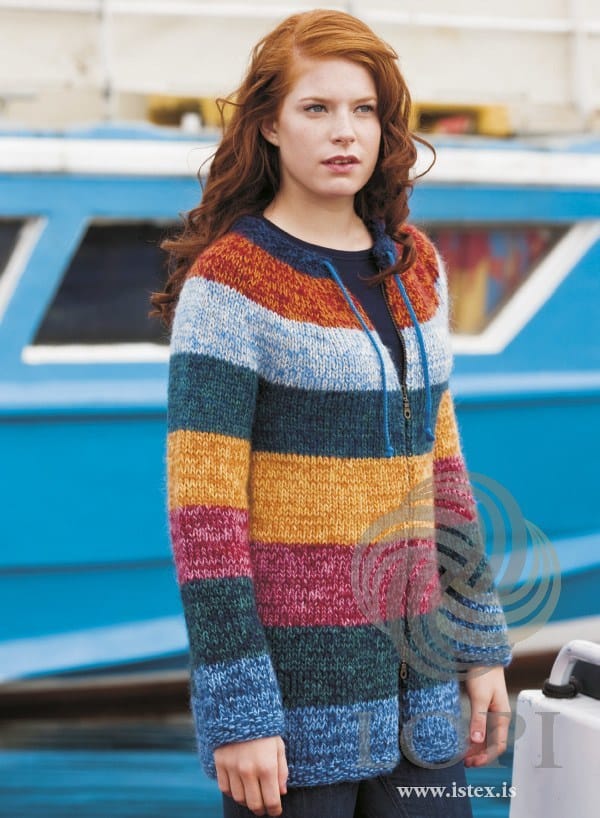
Hamingja — happiness. Védís Jónsdóttir’s zip-up cardigan for women from Ístex’s Lopi 28 is knitted with two strands of Léttlopi held together, so each wide stripe is a blend of two colours: blue, dark teal, raspberry, golden and dark blue-green on the body and sleeves, then a round yoke with a pale blue-grey band, a red-orange band and a dark top. It has moss-stitch edges, a steeked front with a two-way zip, and a folded neckband with a cord. One colour version, in sizes XS to XXL. Two of the nine colours are no longer made — orange (1410) and sun yellow (1411): together they make the golden stripe, and orange with garnet red makes the red-orange yoke band.
What you get
- The knitting pattern in English (PDF), emailed right after purchase — nothing is posted
- Sizes XS, S, M, L, XL and XXL
- The 40-round yoke chart, with a key to the colour pairs
- Yarn and needles are not included. The kit has this pattern and all the yarn: the kit
Yarn used in the pattern (not included)
Léttlopi — 50 g balls · sizes XS (S M L XL XXL) — every stripe is two of these colours held together
A 1403 lapis blue — 3 (3 3 3 4 4)
B 1402 heaven blue — 3 (3 3 3 3 3)
C 9420 navy — 2 (2 2 3 3 3)
D 9423 lagoon — 3 (3 3 3 3 3)
E 1409 garnet red — 2 (2 2 3 3 3)
F 1412 pink — 2 (2 2 2 2 2)
G 1410 orange — 2 (2 2 3 3 3) · no longer made — the kit uses 1704 apricot, a warm ginger orange, darker than the old orange
H 1411 sun yellow — 2 (2 2 2 2 2) · no longer made — the kit uses 1703 mimosa, a warm golden yellow, close to the old sun yellow
I 0054 ash — 1 (1 2 2 2 2)
Sizes
| XS | S | M | L | XL | XXL | |
|---|---|---|---|---|---|---|
| Chest | 82 cm 32¼″ |
88 cm 34¾″ |
95 cm 37½″ |
102 cm 40¼″ |
108 cm 42½″ |
115 cm 45¼″ |
| Width at lower edge (all the way round) | 102 cm 40¼″ |
108 cm 42½″ |
115 cm 45¼″ |
122 cm 48″ |
128 cm 50½″ |
135 cm 53¼″ |
| Length to underarm | 48 cm 19″ |
50 cm 19¾″ |
52 cm 20½″ |
54 cm 21¼″ |
56 cm 22″ |
58 cm 22¾″ |
| Sleeve length to underarm | 45 cm 17¾″ |
46 cm 18″ |
47 cm 18½″ |
48 cm 19″ |
49 cm 19¼″ |
50 cm 19¾″ |
Gauge
12 sts × 18 rows = 10 cm (4″) in stocking stitch with two strands of Léttlopi held together, on 6.5 mm needles.
Needles
6.5 mm (US 10½) circular needles, 40 and 80 cm, for the body and the yoke
5.5 mm (US 9) circular needle, 80 cm, for the moss-stitch hem
5 mm (US 8) circular needle, 40 cm, for the neckband
5.5 mm (US 9) and 6.5 mm (US 10½) double-pointed needles for the cuffs and sleeves — the pattern prints US 10 for the 6½ mm ones; they are US 10½
You will also need
A two-way separating zip (“zipper with 2 slides” — the pattern gives no length), a cord for the neckband (no length or kind given) and stitch markers, all in the pattern’s list; plus stitch holders (or scrap yarn) for the underarm stitches, a sewing machine and matching thread for the steek and the zip, and a tapestry needle for grafting the underarms.
How it is knitted
Knitted with two strands of Léttlopi held together, so every stripe is a blend of two colours. Body and sleeves are knitted from the bottom up. The body starts with a knit row and 6 rows of moss stitch, knitted back and forth on 5.5 mm; then 2 purl stitches are cast on at the front for the steek and the work is joined in the round on 6.5 mm. Five wide stripes run up the body and sleeves — blue (lapis blue + heaven blue), dark teal (navy + lagoon), raspberry (garnet red + pink), golden (orange + sun yellow) and dark blue-green (lapis blue + lagoon) — and three decrease rounds of 8 stitches narrow the body towards the chest. The sleeves start with a moss-stitch cuff on 5.5 mm double-pointed needles and are increased at the underarm. Body and sleeves are joined for the round yoke, a 40-round chart with five decrease rounds: two rounds of lapis blue + lagoon, a pale blue-grey band (heaven blue + ash), a red-orange band (garnet red + orange) and a dark top (lapis blue + navy). The neckband is moss stitch on 5 mm, knitted back and forth, with two eyelets for the cord, and folded to the inside along a ridge. The front is machine-sewn and cut open, and a two-way zip is sewn in.
Design: Védís Jónsdóttir — pattern from Lopi No. 28 (no. 6), Ístex.
More info — download, yarn & help
How you get it — the pattern is a PDF in English. It is emailed to you right after purchase; nothing is posted.
Yarn — not included. We sell Ístex lopi by the ball in our yarn shop, or choose the kit, which has this pattern and all the yarn in one parcel.
No email? Check your spam folder, then write to support@icelandicstore.is with your order number. A person answers, Monday to Friday.
Choose options
Why you'll love it
- Two strands togetherEach stripe blends two Léttlopi colours, knitted together on 6.5 mm needles.
- Wide stripesFive broad stripes run up the body and sleeves, and three more bands colour the round yoke.
- Two-way zipSewn into the cut front, from the hem up into the folded neckband.
- Cord at the neckA folded moss-stitch neckband with two eyelets and a cord knotted at both ends.
Good to know