
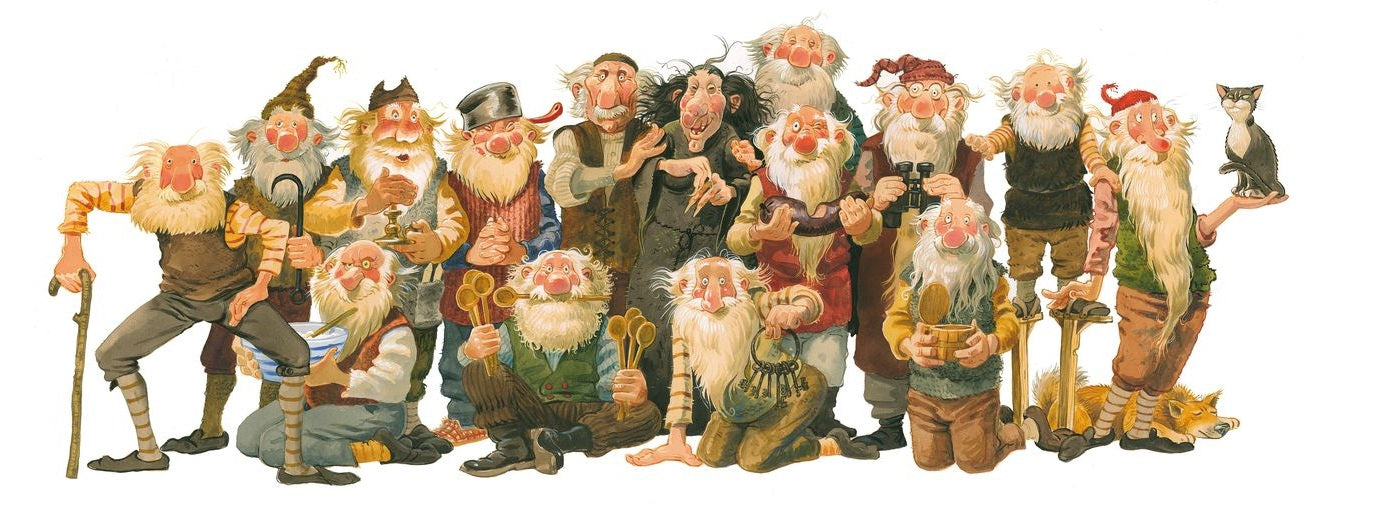
Yule Lads, Grýla & the Yule Cat: Iceland's 13 Santas
Every December, thirteen scruffy brothers walk down from the Icelandic mountains one at a time, their troll mother Grýla gets hungry, and a cat the size of a house starts checking whether you own any new clothes. That is Christmas in Iceland, and we grew up with it. Our family has run The Icelandic Store from Hafnarfjörður since 2013, and every year customers ask us the same three things: who exactly are the Yule Lads, when does each one arrive, and what is the deal with the cat? This guide answers all of it, with the dates, the names in Icelandic and English, and how Icelanders actually celebrate today.
The short version
- The Yule Lads (Jólasveinar) are 13 brothers who visit one per night from 12 to 24 December, leaving small gifts in children's shoes. Iceland has 13 Santas, not one.
- Their mother is Grýla, a mountain troll who eats naughty children. Their father Leppalúði mostly sleeps.
- The Yule Cat (Jólakötturinn) is the family pet: a giant black cat that eats anyone who does not get at least one new piece of clothing before Christmas Eve.
- Christmas itself begins at 6 pm on 24 December. The last Yule Lad leaves on 6 January, Þrettándinn.
Who are the Icelandic Yule Lads?
Jólasveinar (roughly YO-la-svay-nar) means "Yule swains", or Yule Lads. They are the thirteen sons of Grýla and Leppalúði, and they live somewhere up in the mountains for eleven months of the year. In the old stories they are not jolly gift-givers at all. They are hungry, half-wild farm thieves who come down in the darkest weeks of winter to steal food and keep people awake. Each one has a single obsession, and his name tells you what it is.
Over the last century they have softened. Today's Yule Lads still steal a sausage or slam a door, but they also bring presents, visit schools and hospitals, and turn up every morning from 12 December at the National Museum in Reykjavík in old-fashioned wool clothes. Icelandic children love them and are slightly afraid of them at the same time, which is the point.
Why thirteen? A short history
Grýla is far older than her sons. She is named in 13th-century manuscripts, including Snorri Sturluson's Edda, as a troll woman, long before anyone connected her to Christmas. The Yule Lads first appear in writing in the 17th century, and by then they were already being used to frighten children. That got so out of hand that a royal decree in 1746 ordered Icelandic parents to stop scaring their children with Grýla and the Yule Lads.
The number varied from one valley to the next, and so did the names: lads like Faldafeykir ("Skirt-Blower") and Lungnaslettir ("Lung-Flinger") never made the final cut. Folklorist Jón Árnason listed thirteen in his 1862 collection of folk tales, and in 1932 the poet Jóhannes úr Kötlum fixed their names and order in the poem "Jólasveinarnir" in his book Jólin koma ("Christmas Is Coming"). His thirteen are the ones every Icelander can recite today.
The 13 Yule Lads: names, dates and what each one does
Each lad comes down on the night before the date below, so children find his gift in their shoe on the morning listed. He stays for thirteen days and then walks back to the mountains in the same order he came. Stekkjastaur, the first to arrive, is the first to leave on Christmas Day, and Kertasníkir, the last to arrive, leaves on 6 January.
| Icelandic name | English name | Arrives | Leaves | What he does |
|---|---|---|---|---|
| Stekkjastaur | Sheep-Cote Clod | 12 Dec | 25 Dec | Bothers the sheep in their pens and tries to drink the ewes' milk, but his stiff peg legs make it hard to bend down. |
| Giljagaur | Gully Gawk | 13 Dec | 26 Dec | Hides in gullies, then sneaks into the cowshed to skim the froth off the milk pails. |
| Stúfur | Stubby (Shorty) | 14 Dec | 27 Dec | The smallest brother. Steals frying pans to eat the burnt crust left on them. |
| Þvörusleikir | Spoon-Licker | 15 Dec | 28 Dec | Licks the long wooden stirring spoon (þvara) clean. Thin as a rake because of it. |
| Pottaskefill | Pot-Scraper (Pot Licker) | 16 Dec | 29 Dec | Waits until the children are called away, then scrapes the leftovers out of the pots. |
| Askasleikir | Bowl-Licker | 17 Dec | 30 Dec | Hides under the bed and grabs the lidded wooden bowls (askar) people set down on the floor, then licks them spotless. |
| Hurðaskellir | Door-Slammer | 18 Dec | 31 Dec | Slams doors all night, loudest when everyone has just fallen asleep. |
| Skyrgámur | Skyr-Gobbler | 19 Dec | 1 Jan | Breaks into the pantry and eats skyr straight out of the tub until he can barely move. |
| Bjúgnakrækir | Sausage-Swiper | 20 Dec | 2 Jan | Climbs into the rafters where the smoked sausages hang and steals them. |
| Gluggagægir | Window-Peeper | 21 Dec | 3 Jan | Peers in through windows looking for something worth stealing, or just for someone to startle. |
| Gáttaþefur | Doorway-Sniffer | 22 Dec | 4 Jan | Has an enormous nose and uses it to sniff out laufabrauð, the Christmas leaf bread, from the doorway. |
| Ketkrókur | Meat-Hook | 23 Dec | 5 Jan | Lowers a long hook down the chimney to snag the smoked lamb (hangikjöt) cooking for Christmas. |
| Kertasníkir | Candle-Beggar (Candle-Stealer) | 24 Dec | 6 Jan | Follows children to steal their candles. In the old days candles were made of tallow, so he ate them. |
You will see a few names translated differently on figurines and in books: Pottaskefill is often "Pot Licker" or "Pot Scraper", Kertasníkir is "Candle Beggar" or "Candle Stealer", and Ketkrókur is "Meathook". They are the same lads.
The shoe in the window
This is the part Icelandic children care about most. On the evening of 11 December you put a shoe in your bedroom window. If you have behaved, the Yule Lad who comes that night leaves something small in it: a mandarin, a chocolate, a tiny toy, a pack of cards. If you have not, you get a raw potato. Thirteen nights, thirteen chances. Most Icelandic parents will admit that the potato appears at least once per child per December, usually after a particularly loud day.
In our house it is a well-worn indoor shoe rather than a good one. The lads are not fussy, and thirteen nights of chocolate crumbs are hard on a shoe.
Grýla, the troll mother
Grýla (GREE-la) is the real villain of Icelandic Christmas. She is a huge, hideous troll who lives in a cave in the mountains and can hear naughty children from a great distance. In December she comes down with a big sack, collects the children who have misbehaved during the year, carries them home and boils them into a stew. That is the whole story, and Icelandic children have heard it for centuries.
She has been married three times. The first two husbands are barely remembered, and one she is said to have eaten. The third is Leppalúði. Depending on which poem you read she has hooves, horns, fifteen tails, or a bag of ears on her back; what never changes is her appetite. She is the reason to be good, and the Yule Lads are the reward for being good. These days she is played more for laughs than fear, and visitors to the Dimmuborgir lava field near Lake Mývatn can meet the whole family at their "home" each December.
Leppalúði, the useless husband
Leppalúði is Grýla's third husband and the father of the Yule Lads. He is lazy, dim and permanently lying down in the cave waiting for Grýla to bring home the stew, which is why almost nothing happens in his stories. Children find him very funny. In figurine sets he is the tired old man at the back.
The Yule Cat: Jólakötturinn
The Yule Cat (Jólakötturinn, YO-la-kurt-ur-in) is Grýla's cat and the strangest creature in the whole cast. It is enormous, black, and it prowls the countryside on Christmas Eve looking for people who did not receive a single new piece of clothing for Christmas. Anyone it finds, it eats. Children, adults, everyone.
Icelanders still say that someone who gets no new clothes "goes to the Yule Cat" (að fara í jólaköttinn). It is a joke now, but the habit is real: almost every Icelander, of any age, gets at least one new thing to wear before Christmas Eve. A pair of wool socks counts. Many families make sure of it on purpose.
Why would a cat care about your clothes?
The answer is wool. On old Icelandic farms the autumn wool had to be carded, spun and knitted into clothes before Christmas, and everyone in the household was expected to help. Those who did their share were rewarded with a new garment for the holiday. Those who slacked off got nothing, and therefore had nothing to protect them from the cat. The Yule Cat was farm management, a way to get the winter's knitting finished on time. It is also why Icelandic wool and Christmas are so tightly tied together, and probably why so many of our customers are knitting a sweater against the clock in December.
Written records of the Yule Cat only go back to the 19th century, so it is younger than Grýla and the lads, but abroad it has become the most famous of them all.
The Yule Cat poem
The reason the cat is so vivid today is a poem. Jóhannes úr Kötlum put "Jólakötturinn" in the same 1932 book as the Yule Lads poem, and every Icelandic child learns it. It opens with the line "Þið kannist við jólaköttinn" ("You all know the Yule Cat"), and then describes the animal: eyes glowing, whiskers like blades, claws that leave a trail across the snow. The poem follows the cat's Christmas hunt, explains that it was the poor, the people who could not afford new clothes, who were in danger, and ends by asking the reader to help those who have less so that nobody has to face the cat. It is a sharper and kinder poem than the monster suggests. Björk recorded a version of it in 1987, and since 2018 a five-metre lit-up Yule Cat has stood in Lækjartorg square in downtown Reykjavík every December, teeth bared at the Christmas shoppers.
How Icelanders celebrate Christmas today
The folklore is only half of it. Here is what an ordinary Icelandic Christmas looks like now.
- Advent. Lights go up early because it is dark by mid-afternoon. Families gather to cut laufabrauð, the paper-thin "leaf bread" decorated with patterns and fried crisp.
- 12 to 24 December. The Yule Lads arrive one a night, shoes sit in windows, and the lads appear in person at the National Museum in Reykjavík every morning.
- Þorláksmessa, 23 December. St. Þorlákur's Day, named for Iceland's patron saint. Many Icelanders eat kæst skata (fermented skate) at lunch, a smell you never forget, then do their last shopping downtown in the evening, when shops stay open late.
- Aðfangadagur, 24 December. Christmas Eve is the main event. At exactly 6 pm the church bells ring on the radio and Christmas officially begins. Families sit down to a formal dinner, often glazed pork (hamborgarhryggur), ptarmigan or lamb, and the presents are opened afterwards, the same evening. Books are the classic gift; so many are published in November that the season has its own name, jólabókaflóðið, the Christmas book flood.
- Jóladagur, 25 December. A quiet day with the wider family, usually with hangikjöt, smoked lamb, served with white sauce, peas and potatoes. Stekkjastaur heads home.
- Þrettándinn, 6 January. The thirteenth day. Kertasníkir, the last lad, leaves, and Icelanders see Christmas off with bonfires, fireworks and, in the old belief, elves on the move. After that the lights come down.
Bring the Yule Lads home
We stock the Icelandic Yule Lad figurines and ornaments all year, because they get asked for all year. These are the ones customers pick most often.
 Icelandic Yule Lad – Christmas Cat (figurine)
$38.90
Icelandic Yule Lad – Christmas Cat (figurine)
$38.90
 Yule Lads Figures – Set of all 16
$534.00
Yule Lads Figures – Set of all 16
$534.00
 Christmas Cat – Yule Lad Ornament
$25.90
Christmas Cat – Yule Lad Ornament
$25.90
 Yule Lads Christmas Balls Ornaments – Set of all 7
$243.00
Yule Lads Christmas Balls Ornaments – Set of all 7
$243.00
 Icelandic Felted Wool Grýla Ornament
$31.50
Icelandic Felted Wool Grýla Ornament
$31.50
 The Yule Lads: A Celebration of Iceland's Christmas Folklore (book)
$53.90
The Yule Lads: A Celebration of Iceland's Christmas Folklore (book)
$53.90
The figurines and the 16-piece set are hand-painted and based on Brian Pilkington's drawings, which is how most Icelanders picture the lads today. Browse the full Yule Lads figurines collection, the Yule Lads ornaments, or everything in our Icelandic Christmas collection.
Frequently asked questions
How many Yule Lads are there?
Thirteen. Older stories had anywhere from nine to twenty or more, but since Jóhannes úr Kötlum's 1932 poem the number has been fixed at thirteen, one for each night from 12 to 24 December.
When do the Yule Lads come?
The first, Stekkjastaur, comes on the night of 11 December and the last, Kertasníkir, on the night of 23 December. Each stays thirteen days, so they leave one by one from 25 December to 6 January.
Are the Yule Lads Iceland's Santa Claus?
Sort of. They fill the role, leaving gifts for children and appearing in red suits in shopping centres, but they are older, wilder, and there are thirteen of them. The ordinary Santa Claus is known in Iceland too, and the two traditions happily overlap.
What is the Icelandic Christmas Cat?
The Christmas Cat and the Yule Cat are the same creature, Jólakötturinn. It is a giant cat belonging to the troll Grýla that eats people who receive no new clothes before Christmas Eve. The custom of giving at least one new garment for Christmas survives because of it.
What do you have to do to avoid the Yule Cat?
Receive one new piece of clothing before Christmas Eve. Socks are enough. A hand-knitted Icelandic sweater is overkill, but nobody has ever complained.
Is Grýla real?
No. She is a folklore figure, first written down in the 13th century and attached to Christmas a few hundred years later. Icelandic children work this out for themselves somewhere between the potato years and their teens.
Gleðileg jól from all of us in Hafnarfjörður. Put a shoe in the window, and make sure someone gives you socks.


Leave a comment
This site is protected by hCaptcha and the hCaptcha Privacy Policy and Terms of Service apply.